Pull up four different sites for homes in Alpine, New Jersey, and you will get four different answers to the same question. Zillow puts the average home value at $3.2 million as of June 30, 2026. Redfin's March 2026 figures show a $4.0 million median sale price. Realtor.com's April 2026 snapshot for ZIP code 07620 lists a $5.5 million median listing price. Movoto's July 2026 numbers put the median list price at $7.23 million, and its own market trends page had shown a $5,348,500 median sold price just six months earlier, in January.
That is not four sites disagreeing about a stable market. That is four sites each catching a different handful of trades in a town where trades are rare. And once you understand why the number moves that much, you start asking a better question than "what's the median price," because in Alpine the number that actually decides what a property is worth to you has nothing to do with the portal you happened to open.
A Market With Only a Few Trades a Year
New Jersey's 2025 residential statistics recorded just 17 Alpine sales for the full year, and county-level reporting through March 2026 showed only 2 year-to-date closings against 21 active listings at that point in the year. A borough this size, at 4,095 acres and 6.4 square miles with little remaining vacant land, simply does not generate enough transactions to smooth out a monthly average the way a larger Bergen County town does. When one $9 million estate closes in a month with three total sales, the median jumps. When a modest colonial closes instead, it falls. Neither move tells you the market got hotter or cooler. It tells you which handful of houses happened to change hands.
This is also why Alpine has no condominium, co-op, or townhouse sales or active listings in county data through March 2026, and why ZIP 07620 showed zero rental inventory as of the same reporting period. There is effectively one product type here: detached single-family homes on large lots. That narrows the sample even further, and a narrow sample is a noisy sample.
Days on Market Tell the Same Story
If the price figures disagreed by accident, you would expect the secondary numbers to line up. They do not. One source reported a median of 166 days on market in July 2026, unchanged from July 2025. A separate market trends read for the same year showed an average of 127 days in January, down sharply from 350 days the year before. County-level board data put the year-to-date average at just 38 days through March 2026.
Three numbers, three different pictures of urgency, all describing homes in the same 6.4 square miles during overlapping months of the same year. None of them is wrong. Each is measuring a different, small set of closings, and in a market this thin, that is what "measuring the market" actually looks like.
The Number That Actually Decides What You Can Build
Once the price figures are understood as noise rather than signal, the more useful question becomes what a specific parcel is worth to you, and that answer runs through Alpine's own zoning code rather than any pricing model.
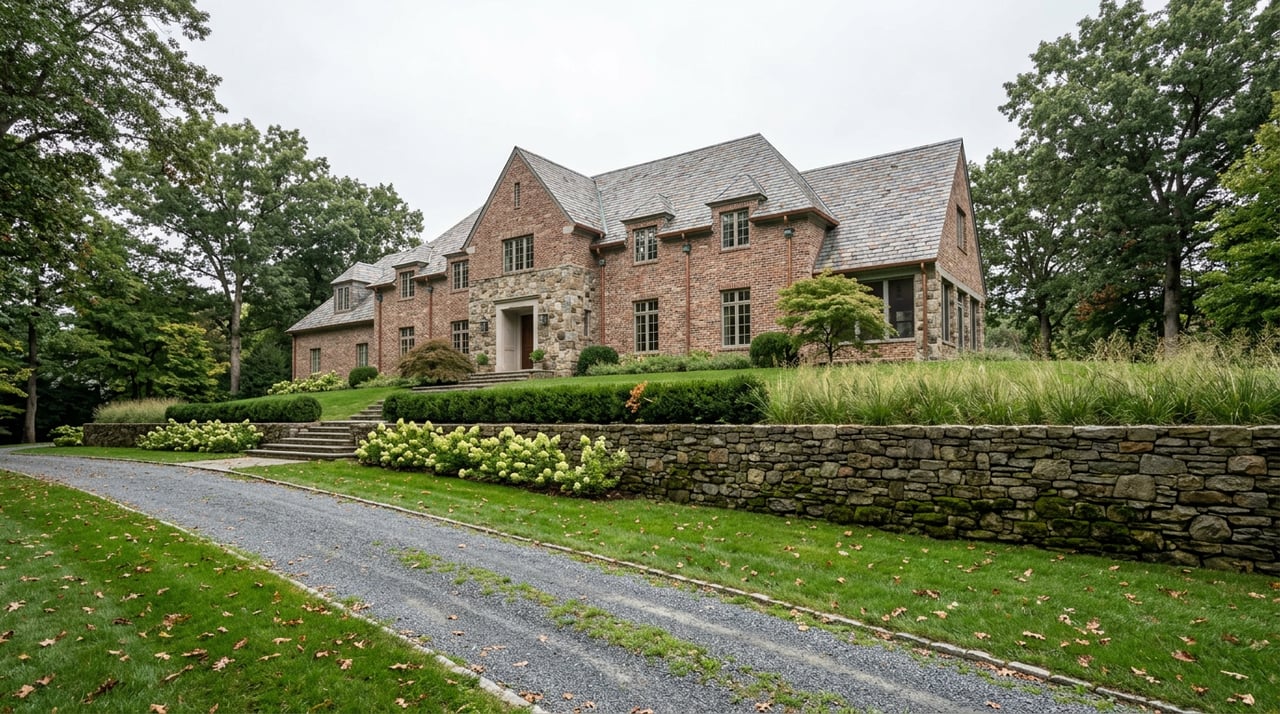
Alpine's zoning ordinance regulates new construction on any property containing a slope of 15 percent grade or greater, measured over a 30-foot horizontal run using two-foot contour intervals. The restriction tightens as the grade increases, and disturbance is barred entirely once a slope reaches 35 percent grade. That means an acre of land advertised on a listing sheet is not automatically an acre you can build on. A topographic survey and slope area calculation, submitted to the Construction Official, is what actually determines the buildable footprint, and larger earthwork can trigger Planning Board review under the borough's site plan and soil movement chapters.
Layer that onto Alpine's minimum lot sizes, which run from 20,000 square feet in the R-2 zone up to a full 2 acres (87,120 square feet) in the R-A and R-R zones, and you get a picture where the deed's acreage figure and the buildable acreage figure can be meaningfully different numbers. New construction or additions in the R-A, R-AA, R-1, and R-R zones are also required to include drainage and erosion control plans, a direct acknowledgment that slope and rocky soil conditions are the rule here, not the exception.
What a 2.55-Acre Parcel on Route 9W Actually Bought
Land carries real weight in this market independent of any structure sitting on it. A 2.55-acre vacant parcel on Route 9W sold for $1.45 million in April 2025, with no home included in the price. That figure confirms something buyers moving from denser Bergen County towns often underestimate: in Alpine, the dirt itself is priced like a finished asset.
What that same listing sheet would not tell you is how much of those 2.55 acres sits above the 15 percent threshold where disturbance rules apply, or whether any portion crosses the 35 percent line where building stops being possible at all. Two parcels priced identically per acre can carry very different development budgets and timelines once an engineer runs the actual slope survey. A straightforward project on a gently sloping lot with existing utility access can move from permit to certificate of occupancy in a matter of months. A project that needs variances, significant earthwork, tree mitigation, or DEP-level review should be budgeted for a year or more from first application to final sign-off.
Sewer versus septic adds another variable to that math. Connecting to an existing sewer service area is generally simpler and less costly than designing and maintaining a private septic system, and not every Alpine parcel sits inside a mapped service area. That is worth confirming with the utility directly before treating any two lots as comparable on cost.
Reading the Tax Line the Same Way
The instinct with a high headline price is to assume the carrying costs scale with it. New Jersey's 2025 municipal data lists Alpine's general tax rate at 0.837 percent and its effective rate at 0.794 percent, which comes in lower than several other luxury Bergen County towns. The average assessed value in that same dataset was $2,782,718, with an average tax bill of $23,291. Your own bill will follow your property's specific assessment, not the town average, but the pattern holds with everything else here: the headline number and the number that governs your actual outlay are not the same thing, and neither is automatically derivable from the other.
What This Means If You're Comparing Alpine to Another Town
If you are cross-shopping Alpine against Saddle River, Franklin Lakes, or Upper Saddle River using median price or price per acre pulled from a portal, you are comparing numbers built from very different sample sizes and very different underlying land constraints. A price-per-acre figure in a town with fewer steep-slope parcels and smaller minimum lots is not measuring the same thing as a price-per-acre figure in Alpine, where the 35 percent disturbance cutoff can remove a meaningful share of an otherwise attractive lot from consideration entirely.
The more reliable approach is to treat any published median as a rough locator, not a valuation, and to request a slope survey and buildable-area calculation before comparing land costs across towns or committing capital to a specific parcel.
Frequently Asked Questions
Why doesn't Alpine have any condos or townhomes on the market? County data through March 2026 recorded no condominium, co-op, or townhouse sales or active listings in the borough, and ZIP 07620 showed zero rental inventory in the same period. The housing stock here is built almost entirely around detached single-family homes on large lots, which is consistent with Alpine's zoning pattern and its limited remaining vacant land.
If a listing says 2 acres, does that mean 2 buildable acres? Not necessarily. Alpine's zoning code regulates disturbance starting at 15 percent grade and prohibits it entirely above 35 percent. The only way to know how much of a given lot is actually buildable is a topographic survey with a slope area calculation submitted to the Construction Official.
Why is Alpine's effective tax rate lower than some neighboring luxury towns despite higher home prices? Tax rates are set locally based on a municipality's budget needs relative to its total assessed value, not directly on individual home prices. Alpine's 2025 effective rate of 0.794 percent reflects that local calculation, and it happens to sit below several comparable Bergen County towns even with high per-property valuations.
Working Through the Numbers With Someone Who Reads Them for a Living
A market this thin rewards patience and precision more than speed. Before you anchor a decision to a median price you saw on a screen, or a price-per-acre figure that assumes every acre is equally buildable, it is worth having someone pull the actual slope survey, the actual zoning schedule, and the actual sales history behind a specific address. The Luberto Group works with buyers and sellers across Bergen County's most tightly held enclaves, Alpine included, and brings both real estate representation and an operator's eye for the diligence that headline numbers tend to skip. If you are weighing a purchase or a sale in Alpine and want to see what a specific property's numbers actually mean, reach out and we will walk through it together.